featured slide

Bloggerized by Nauman Khan

featured slide

Bloggerized by Nauman Khan

featured slide

Bloggerized by Nauman Khan

featured slide

Bloggerized by Nauman Khan

featured slide

Bloggerized by Nauman Khan

Friday, May 18, 2012

Black Holes Can Block Star Birth With Intense Energy, Study Confirms


Black Hole
An artist's illustration of the view into a black hole.
By: Charles Q. Choi 
Published: 05/09/2012 01:12 PM EDT on SPACE.com
The intense energy and winds from gigantic black holes can block the birth of stars as scientists have long suspected, a new analysis of distant galaxies reveals.
Most galaxies, including our own Milky Way, are thought to have supermassive black holes at their hearts. Some of these monster black holes are relatively calm, but others, known as "active galactic nuclei," or AGN, can spew out more radiation than our entire galaxy does, and from a patch of space no larger than our solar system.
Scientists had long thought all this energy from active galactic nuclei quenched the formation of stars around them.
"There is so much energy in the radiation coming out from the AGNs, that if the surrounding gas absorbs just a small fraction — about one-twentieth will do it — it will have enough energy to escape from the host galaxy, and effectively becomes a wind clearing the galaxy of gas," said study lead author Mathew Page, an astrophysicist at University College London. "Once the gas has been heated up and driven out, there's no material from which to form stars." [Gallery: Black Holes of the Universe]
Proving whether this star-stifling occurs has been a problem because measuring star formation in galaxies containing powerful active galactic nuclei has long been difficult. The radiation from these jumbo black holes outshines that from star formation in nearly all wavelengths of light.
The best chance to find this evidence lies in the far-infrared to millimeter wavelengths of the electromagnetic spectrum, since active galactic nuclei emit comparatively little radiation at these wavelengths.
The research is detailed in tomorrow's (May 10) issue of the journal Nature.
Submillimeter observations from the Herschel Space Observatory revealed that rapid star formation was common in the host galaxies of active galactic nuclei when the universe was 2 billion to 6 billion years old. However, X-ray observations from the Chandra X-ray Observatory showed that vigorous star formation was not seen around black holes that had X-ray luminosities of 10^44 ergs per second. (An erg is a unit of energy, and 10^44 is short for a 1 with 44 zeroes behind it.)
"10^44 ergs per second is about 25 billion times the luminosity of the sun; it is about 10 times the luminosity of the Milky Way," Page said. "But this is only the luminosity of the active galactic nucleus in X-rays — it will radiate about 20 times as much power over the rest of the electromagnetic spectrum."
All this energy should be enough to drive powerful outflows of gas, stripping the areas around the black holes of stellar construction materials.
Future research can focus on "catching some galaxies as they're actually going through the stage of having their star formation switched off, rather than seeing them before or after, as we do for most of the objects we've looked at here," Page said. "The biggest obstacle to that is the need to have infrared and X-ray observatories in space. A successor to the Chandra and XMM-Newton X-ray observatories is what I'd like."


What the Facebook IPO Means


It's electrifying here in Silicon Valley this week, even more so than usual. Normally, many of us are heads down, focused on our own companies, but right now, even in the land of "what's next?" all anyone can talk about is the Facebook IPO.

This week marks the dawn of a new era. Facebook going public -- with a billion users worldwide and $3.7 billion in revenue -- confirms that Facebook is doing to Google today what Google did to Microsoft nearly a decade ago. It's hard to believe that it's been eight years since the Google IPO.
What's changed since Google was the new, hot company that toppled Microsoft in consumers and investors' hearts?
For one, consumer behavior has changed. In the Google era, people learned to search for information, products, and businesses. But over the last five years, Facebook has altered online behavior. In the Facebook era, people now choose to share and discover rather than simply search for information.
A growing number of people worldwide now get their news as well as learn about products and services through what their friends are reading, liking, and buying -- all this, of course, is broadcast through the Facebook news feed, Twitter streams, and LinkedIn Today.
As a result, Facebook replaced Google as the most visited site in the U.S. in 2010, according toExperian Hitwise. Now, Facebook is even overtaking Google in the amount of traffic it drives to third-party sites, including Guardian UK. By establishing trusted graphs of friends and brands one likes or follows, social networking sites have transformed the way people are making important decisions such as what to read, what to buy, where to buy, and whom to hire.
Hence the $3.7 billion in revenue. And this is just the beginning.
The future is bright
Indeed, Facebook's best days are still ahead. There is strong near-term upside in the new ad formats they have created. New Facebook ad products like Sponsored Stories and Reach Generator, which broadcast Business Page "likes" and posts to wider audiences, are already showing great promise by driving conversion rates higher for marketers.
In the medium term, Facebook is well positioned to monetize on mobile, payments, and international growth. Over 55 percent of its 901 million users are active on Facebook Mobile, and this number just keeps growing as more people get smartphones. In its S-1, Facebook disclosed it already generates nearly 18 percent of its revenue from payments generated from the 30 percent "tax" it charges for transactions involving virtual or digital goods (think vegetables in Farmville -- the broccoli adds up!). On the international front, Facebook has had great user growth but only scratched the surface in terms of monetization.
Long term, the possibilities are endless. The convergence of Facebook and well-established online business models such as search, commerce, and ad networks could be very compelling for consumers, in addition to being lucrative for Facebook. For example, why couldn't search be social? If I search for "digital camera," why should I see the same organic and paid results as my 11-year old niece who would respond much better to a lower-end model that's pink? And why should she or I see the same results as my husband's friend who is a professional photographer and would clearly be interested in a very different kind of digital camera?
Facebook could also partner or compete head-on with traditional offline channels such as TV, digital dashboards in automobiles, and smart billboards enabled with near field communication that tailor their displays to whomever may be nearby.
In conclusion
Silicon Valley is roaring again. From LinkedIn, Zynga, and Yelp to Facebook and its rapidly expanding partner ecosystem, innovation is alive and well. A heartfelt congratulations to the team at Facebook on their IPO and, indeed, for changing the world. Stay focused and keep shipping.

Ruchi Sanghvi, Facebook's First Female Engineer: 'It Was Difficult To Break Into The Boys' Club'

Ruchi Sanghvi Facebooks First Female Engineer


When Ruchi Sanghvi arrived for her first job interview at Facebook's headquarters, no one was there.
It was the fall of 2005 and when she reached thestartup's graffiti-covered offices in downtown Palo Alto at noon, they were empty. Two hours later, she was still waiting. At 3 p.m., someone finally arrived to interview her -- the engineers had been up all night coding and slept in, she learned later.
Sanghvi was undeterred. Impressed by the place, the people, and the product, which she had spent hours using as a student at Carnegie Mellon University, she became Facebook's first female engineer, one of the first 10 engineers hired by the company.
Sanghvi's five-year career at Facebook underscores the meritocratic nature of the startup world, where a bright, young engineer like Sanghvi, who was raised in the industrial town of Pune, India, and didn't regularly use a computer until her freshman year of college, could play a key role in shaping one of the world's most influential web companies.

Yet her experience also sheds light on the challenges female engineers faced then -- and still face -- in a male-dominated field. Sanghvi's story illustrates that despite all the talk of equality between the sexes, women often grapple with a unique set of difficulties when it comes to finding role models in the engineering field and making inroads into what she called "the boys' club."

During her tenure at Facebook, Sanghvi not only watched the company explode into a global network with a population greater than that of the United States, but also built the social network's most defining features. She launched News Feed, which radically changed the Facebook experience by putting friends' online activities front and center on the site; Platform, an update that allowed third-party developers and entrepreneurs to build apps on Facebook; and Connect, which made it possible for people to link their Facebook identities and friends to almost any site on the web.

The products she developed helped propel the site forward and also rewrote the rules of the web, eroding anonymity on the Internet and ushering in a new age where peoples' real names were attached to everything they did online. Sanghvi describes this connection between offline and online identities as the next big idea in tech, one that will reshape everything from e-commerce to health care.

"Facebook has woven itself into the fabric of our lives and the foundation of the Internet," Sanghvi said. "I think everything will be redefined because people are using their real identities on the Internet."
Sanghvi said she was used to being the odd woman out -- she was one of five female students out of 150 in a course in the Electrical Computer Engineering department -- and at Facebook, she again found herself on a team with only a handful of female engineers.
Though she looks back fondly on her time at Facebook and describes it as "one of the best companies to be working at right now," she said her male co-workers enjoyed a certain camaraderie that she could not match or fully penetrate.
"It was difficult to break into the boys' club," Sanghvi said. "I wish that females had a similar culture or support network."
Sanghvi said the male engineers on her team created a "brogramming page," presumably only for the Facebook "bros" who were programming. She recalls having to change her working style to adapt to the "aggressive" environment, a shift she said affected how she was perceived.
"Engineers are either aggressive or passive aggressive. You need to just dive straight into it, and sometimes there are social repercussions because of it," Sanghvi explained. "The impression that people had of me was that I was really harsh, hard-edged, brusque and to the point. All of that happened because I am a woman, and I was acting in that kind of environment."
Facebook declined to disclose what percentage of its current total staff and engineers are female. The company does not have any affirmative action programs or quotas in place to attract female engineers, though Facebook supports and funds interest groups, such as Facebook Women or Women Engineers, that its employees create.
"Increasing the number of women in the tech sector is hugely important to Facebook," a Facebook spokeswoman said. "We want our company to reflect the diverse global community that we serve."
Facebook COO Sheryl Sandberg has also been an outspoken advocate for increasing the number of female leaders.
"Men run the world," Sandberg said in a May 2011 commencement address delivered at Barnard College. "We need women at all levels, including the top, to change the dynamic, reshape the conversation, to make sure women's voices are heard and heeded, not overlooked and ignored."
To Sanghvi, increasing the number of women in tech requires not only HR initiatives, but also having more female role models in engineering, computer science and other technical fields.
"Kids in college often look for mentors and role models to model their careers after, and women don't have the equivalent of a Steve Jobs or Bill Gates," Sanghvi said. "I think it's a self-perpetuating loop."
She also noted that women must ultimately be proactive about choosing their fate, and shared what she said is the most important lesson she's learned thus far in her career: "If I don't ask for something, I'm not going to get it."
Even as she is candid about the challenges she faced at Facebook, Sanghvi, who left in 2010 to start her own company, Cove, praised the tech industry for consistently rewarding excellence and ability above all else.
"It may not be a meritocracy, but it is the closest thing to a meritocracy in the working world,” she said. “I think that itself is very powerful."

Microsoft’s Windows 8 Consumer Preview


Apple’s iOS platform seemed to come out of nowhere and take the world by storm in 2007. The introduction of the first-generation iPhone set in motion a chain of events that lead up to the holiday quarter in 2011, when Apple recorded the most profitable quarter in technology history thanks mainly to unbelievable iPhone, iPod touch and iPad sales. No platform is selling as quickly as Apple’s mobile platform right now, but iOS is still in its infancy and the fact remains: as hot as iOS is right now, and as popular as smartphones and media tablets are, no platform installed base on the planet even comes close to approaching the size of Windows right now.

THE FUTURE

Microsoft said this past December that there are now more than 1.25 billion PCs running the Windows operating system. Billion, with a “B.” Smartphones are the hottest segment in consumer electronics right now and people are buying Apple’s iPad in droves, but even still, more people around the world rely on Windows than ever before. This is because the software that powers countless businesses from the ground up is built on Windows. From web browsers to accounting software to point-of-sale systems to 3D animation software to word processors to custom proprietary solutions and far, far beyond… Entire industries are built on Windows.
The future is anything but “post-PC.”
We are now entering the post-post-PC era, and its focus is the PC. A new, smarter, more versatile PC. A PC that lets users browse the web casually in bed and work with massive databases in SQL Server. A PC that can run a $0.99 news reader as well as it can run proprietary $99,000 CRM software. A PC that is as ideal for playing Angry Birds as it is for running a modeling environment that allows its user to build schematics for a skyscraper. This is the future of computing.
That is not to say Windows 8 is an “iPad killer” or that media tablets are going away. Far from it. While their functionality may overlap in a number of areas, light-duty tablets and full-fledged PCs serve different purposes and will continue to coexist for some time. What we will see, however, is media tablets becoming more capable and more powerful as PCs become better suited for touch input. At some point down the road the two categories may merge, but neither will “win” or “lose.”

THE OS

I’ve spent the past week playing with and working on a Samsung tablet powered by Microsoft’s new operating system. It’s nice to be able to work and play on the same tablet.
While Windows 8 is not quite in a state where it is ready to be released to the public, it is a completely different beast than the Developer Preview Microsoft released more than five months ago. During a meeting with Microsoft executives, I was told that the Consumer Preview version of Windows 8 includes tens of thousands of changes compared to the version that was released to developers in September. Thousands of changes are system-level items that I’m sure I didn’t notice, but thousands more are user-facing changes that have helped improve the user experience dramatically.
One of my favorite features is the implementation of swipe gestures. As can be seen in the second and third images within our Windows 8 screenshot gallery, Microsoft has tweaked the main menus used to navigate the OS and perform a variety of key functions. While using a touchscreen to interface with Windows 8, these menus are opened using gestures.
A swipe from the bezel around the screen in from the right opens the start menu, which includes a search button to search for files and apps, a share button to share the current page via email or using other services, a start button, a devices button that lists devices connected to your PC, and a settings button that provides quick access to basic settings such as brightness and speaker volume, as well as a link to more system settings. A swipe in from the left switches between open apps, and a swipe in from the left and back out to the edge of the display opens the app-switcher. Within an app, a swipe down from the top or up from the bottom opens app-specific menus.
While using a keyboard and mouse, gestures from the sides are replaced by keyboard shortcuts or mouse touches to the corners of the screen. A touch to the top-right or bottom-right corner mimics a swipe in from the right and opens the start menu while a touch to the top-left or bottom-left corners opens the app-switcher.
There are countless other great features new Windows 8 Consumer Preview; from picture password, an enhanced security feature that lets the user unlock a PC by tracing preset patterns on an image of his or her choosing instead of using a simple alphanumeric password, to “roaming,” which automatically syncs settings, apps and other data between different Windows 8 computers. While one convertible slate can handle duties as a tablet, notebook and desktop computer, Windows 8 is all about choice. Some users may opt for a single device while others will want a lightweight 7-inch ARM-based tablet in addition to an eight-core beast of a desktop PC.
In terms of performance, Windows 8 exhibited the smoothness and stability we’ve come to expect in a post-Vista world, and this is just a preview version. There were hiccups, of course, but overall the experience was vastly superior than it has been with any other version of Windows. The setup is remarkably fast and easy, touch responsiveness is iPad-like and I was quite impressed with the versatility of this platform. To understand the concept of one device for work and for play is one thing. To sit in bed hopping around lightweight apps and then walk over to your desk, dock your tablet, and have desktop-grade productivity software running on the same device is something else entirely.
The machine I tested Windows 8 on is a pre-release dockable Samsung tablet with a 1.6GHz Intel Core i5 processor and 4GB of RAM. Yes, it’s a tablet with a fan. It’s also a tablet that can run your existing desktop-grade enterprise software, consumer software and lightweight Metro-style apps. Get over it.

THE ENDGAME

Windows 8 gives us a glimpse at the future of computing, but it’s not quite there yet. While the version I spent time with is merely the Consumer Preview and not the release build of Windows 8, it gives us a very good idea of what Microsoft’s new operating system will look like when it launches. The concept is fantastic and I very much like Microsoft’s execution thus far, but it still feels like a marriage of two completely different operating systems rather than a fusion of two experiences.
This is by design, in part. Because the function of a true PC varies so greatly from the function of a media tablet (as we know this category of devices today), Microsoft has created separate experiences for each category. There is a tablet experience with the fantastic Metro UI, a desktop experience reminiscent of Windows 7, and a bit of overlap with each, intended to create some amount of cohesiveness. The end result, however, is not a consistent experience.
There is a disconnect that can be felt across Windows 8. Again, this is mostly by design. In what I call “tablet mode,” the user is presented with an interface that is quite clearly built to be touched. It is characterized by a cascade of large tiles that display live data and can be poked to open apps. The Metro-style apps that are revealed house nice big buttons and a touch-friendly design. Metro-style apps also take up every last pixel of the display, which is a fantastic canvas on which developers can paint terrific experiences.
In “desktop mode,” Windows 8 has the look and feel of Windows 7. In fact, it basically is Windows 7. There are some elements of Metro that spill over into desktop mode — such as the app-switcher and Windows Phone-like lock screen, which displays notifications from up to five apps — but they are effectively completely separate platforms.
Desktop mode has not been optimized for touch at all. In fact, tapping in a text field while no physical keyboard is attached to the tablet doesn’t even bring up the virtual keyboard. Instead, the user must tap on a small keyboard icon in the task bar to open the keyboard, and then he or she must tap another two buttons to close the keyboard once finished typing. And while in desktop mode, by the way, I found that the keyboard often obscured the text field in which I was typing.
Perhaps I can better illustrate my point about the disconnect with this simple example:
Windows 8 ships with two completely separate web browsers. One is called “Internet Explorer”. The other is called “Internet Explorer.”
Internet Explorer is a fantastic Metro-style browser that is designed with touch in mind. Controls are large and easy to poke, menus retract and let web pages occupy every inch of the display, and pages load lightning-fast in this lightweight tablet browser. Then, in desktop mode, users can browse the web using Internet Explorer, the same robust web browser hundreds of millions of people currently use around the world on their Windows PCs.
Confused yet?
Microsoft’s inclusion of two completely different web browsers that share the exact same name is indicative of the separation present in Windows 8. One tablet OS and one desktop OS, together on the same machine.
In the end, this disconnect is probably a good thing for now. Windows users come in all shapes and sizes, and millions of people who will upgrade to Windows 8 in the coming years will be terrified of doing so. They are used to Windows as we know it today, and the look and feel of Metro is a complete departure from the Windows they currently rely on day in and day out. After the initial shock wears off, these people who are so scared of change will find themselves eased into the new Windows because desktop mode is so familiar, and because “tablet mode” is so separate from it.
But this is not the future of post-post-PCs.
Windows 8 is the tip of the iceberg. The start of a shift that will eventually see the “tablet” UI and the “desktop” UI merge into one comprehensive user experience. Apple is taking a different approach; as we’re seeing in OS X Mountain Lion, Apple is slowly readying its desktop user interface for a touch environment by taking some of the elements from its gorgeous mobile UI and adapting them for desktop computers. This varies dramatically from the path Microsoft is taking with Windows 8, but the endgame is the same: one experience that is as capable as it is versatile, and as user-friendly as it is beautiful.
This is the future of computing.
Microsoft’s Windows 8 Consumer Preview will become available to the general public on Wednesday as a free download with an initial cache of more than 100 apps in the Store, all of which will be free during the preview period.

Top Most Amazing Technology Inventions This Week


Here are most amazing technology inventions for your interest. You can see some astonishing technologiesin picture below like Smart phone, Keyboard, Camera that can take pictures in dark atmosphere and many more.
Observe yourself that technology has changed the things into an unbelievable level.


How To Turn Your Facebook’s Timeline Into Movie


About Facebook Timeline:

In the past few months, Facebook had launched a timeline feature which provides the users the knowledge of their activity on facebook by date and time. In the facebook timeline profile of your friends, you can view the activities of your friends by date and time. For example, if you want to view any activity of your friend in the month of November in 2011, then you can just click on the November month in 2011 on the timeline profile of facebook, and you can gain access to every activity that your friend has done in the month of November.

Make your movie:

Recently, the facebook timeline profile has included a new application. This application can turn your facebook timeline profile into a movie. By making a timeline movie of your profile, you can view your most liked posts and photos in the form of a video. This task is not so tough and you can use this application without any hard work.
The main thing you have to do is to visit the application which is named as Timeline Movie Maker which is available on the website. At this webpage you will get an option at the bottom of the page featuring Make Your Movie. Just a single click on that option and you will be able to convert your timeline profile into a movie.
Facebook's Timeline Movie Maker
Facebook’s Timeline Movie Maker
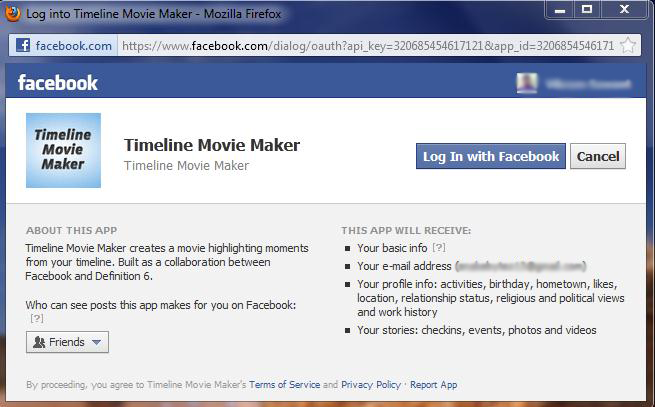
After this process, a webpage will pop-up which will ask you to enter application by logging in into your profile. On the right top corner of the web page, you will find an option which specifies Log In With Facebook. Some information was given on this page following with some requirements which will be used by this application such as the basic info of your profile, your email address, the activities of your profile, and the recent story of your profile.
Facebook's Timeline Movie Maker
Facebook’s Timeline Movie Maker
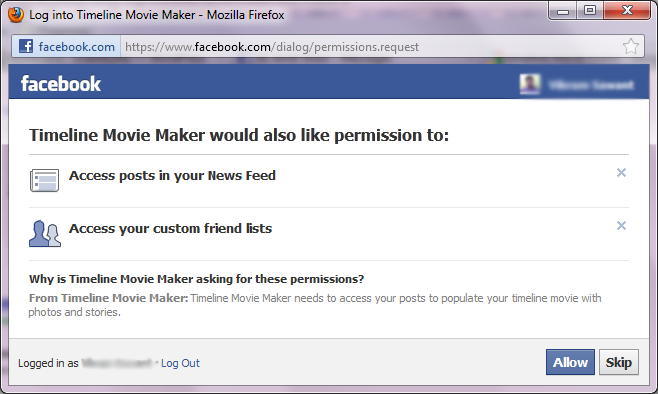
Once you done logging in the app with your facebook profile, you have to permt the app to access posts in your news feed and access your custom friend lists by pressing the Allow button.
You have to just click on that option if you are satisfied with all the conditions which are mentioned below and are required for this application.
After clicking on that option, your movie will now be processed and this will take some time. And after the completion of this process, you can now enjoy the show.
Note: To make your movie, you need at least 50 photos that you’ve shared with Friends or Public.
This article is written by Blake Sanders. He is an expert on link building with a focus on high quality. Blake writes for The Search Labs link building agency

Believe It or Not!


Impaled Alive… UNBELIEVABLE!

IMPALED ALIVE… UNBELIEVABLE!

THE VIDEO IS VERY GRAPHIC! VIEWER DISCRETION ADVISED!

The Asian Institute of medical sciences Hospital Team, Delhi, India Led By Dr. N K Pandey FRCS, saves life of a Biker who crashed into a truck full of iron rods. The rare surgery lasted for 4 hours and resulted in the rods being removed by a team of 14 surgeons and technicians. The boy is alive and recovering in the ICU. God bless him. (Delhi , India Jan 2011).

Thursday, May 17, 2012

6 Habits of Truly Memorable People

unique


535
Share

While you don't have to be The Most Interesting Man in the World, being known is one of the main goals of marketing, advertising, and personal branding.In order to succeed, almost everyone—whether business owner or employee—must be memorable.

Out of sight is out of mind, and out of mind is out of business.
But if your only goal is to be known for professional reasons, you're missing out. People who are memorable for the right reasons also live a richer, fuller, and more satisfying life. Win-win!
So forget the flashy business cards and personal value propositions and idiosyncratic clothing choices.
Here's how to be more memorable—and have a lot more fun.

1. Don't see. Do.

Can you speak intelligently about how clothing provides a window into the inner lives of Mad Men characters? Do you find yourself arguing about how the degree of depth lost in the Game of Thrones TV series as compared to the books?
Anyone can share opinions about movies or TV or even (I'll grudgingly admit) books. That's why opinions are quickly forgotten. What you say isn't interesting; what you do is interesting.
Spend your life doing instead of watching. Cool things will happen. Cool things are a lot more interesting and a lot more memorable.
That's especially true when you...

2. Do something unusual.

Draw a circle and put all your "stuff" in it. Your circle will look a lot like everyone else's: Everyone works, everyone has a family, everyone has homes and cars and clothes....
We like to think we're unique, but roughly speaking we're all the same, and similar isn't memorable.
So occasionally do something different. Backpack to the next town just to see how many people stop to offer you a ride. (Don't take them up on it, though. Unless you appear to be in distress, the people who want to give you a ride are the last people you want to ride with.) Try to hike/scramble to the top of a nearby mountain no one climbs. (Trust me; take water.) Compete with your daughter to see who can swim the most laps in three hours. (If you live in my house you'll lose. Badly.)
Or work from a coffee shop one day just to see what you learn about other people... and about yourself.
Whatever you do, the less productive and sensible it is, the better. Your goal isn't to accomplish something worthwhile; the goal is to collect experiences.
Experiences, especially unusual experiences, make your life a lot richer and way more interesting. You can even...

3. Embark on a worthless mission.

You're incredibly focused, consistently on point, and relentlessly efficient.
You're also really, really boring.
Remember when you were young and followed stupid ideas to their illogical conclusions? Road trips, failing the cinnamon challenge, trying to eat six saltine crackers in one minute without water... you dined out on those stories for years.
Going on "missions," however pointless and inconvenient, was fun. In fact the more pointless the more fun you had, because missions are about the ride, not the destination.
So do something, just once, that adults no longer do. Drive eight hours to see a band. Buy your seafood at the dock. Or do something no one else thinks of doing. Ride along with a policeman on a Friday night (it's the king of all eye-opening experiences.)
Pick something it doesn't make sense to do a certain way and do it that way. You'll remember it forever—and so will other people.

4. Embrace a cause.

People care about—and remember—people who care. When you stand for something you stand apart.
But...

5. Let other people spread the word.

People who brag are not remembered for what they've done; they're remembered for the fact they brag.
Do good things and other people will find out. The less you say, the more people remember.

6. Get over yourself.

Most of the time your professional life is like a hamster wheel of resume or C.V. padding: You avoid all possibility of failure while maximizing the odds of success in order to ensure your achievement graph climbs up and up and up.
Inevitably, that approach starts to extend to your personal life too.
So you run... but you won't enter a race because you don't want to finish at the back of the pack. You sing... but you won't share a mic in a friend's band because you're noAdele. You'll sponsor the employee softball team but you won't play because you're not very good.
Personally and professionally, you feel compelled to maintain your all-knowing, all-achieving, all conquering image.
And you're not a person. You're a resume.
Stop trying to seem perfect. Accept your faults. Make mistakes. Hang yourself out there. Try and fail.
Then be gracious when you fail.
When you do, people will definitely remember you because people who are willing to fail are rare... and because people who display grace and humility, especially in the face of defeat, are incredibly rare.