featured slide

Bloggerized by Nauman Khan

featured slide

Bloggerized by Nauman Khan

featured slide

Bloggerized by Nauman Khan

featured slide

Bloggerized by Nauman Khan

featured slide

Bloggerized by Nauman Khan

Wednesday, January 16, 2013

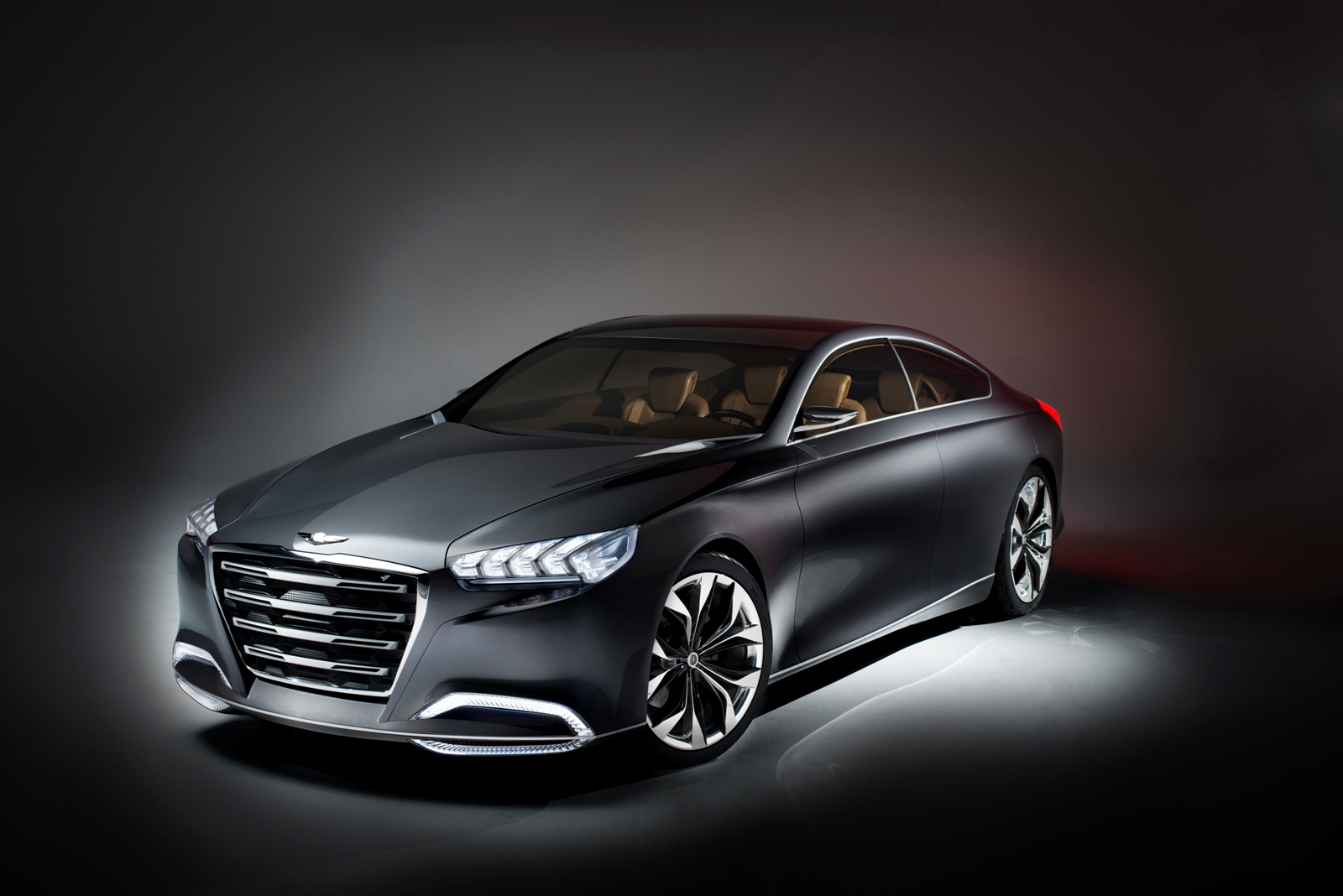
Hyundai HCD-14 Genesis concept unveiled at Detroit Auto Show


Hyundai HCD-14 Genesis concept profile

The HCD-14 Genesis is meant to push Hyundai further into luxury territory with sophisticated styling and 3D gesture recognition technology.

Hyundai HCD-14 Genesis front three quarter

The eye tracking feature allows the driver to select a function, while the 3D system allows him or her to use minimal gestures to make their selection.

These new technologies help the driver control audio, navigation, HVAC, and smartphone connectivity functions. Combined with a head-up display, Hyundai says eye tracking and gesture recognition keep the driver’s eyes on the road the majority of the time.

This may be a concept car, but Hyundai decided to make it drivable as well. However, the drive train is more realistic than the styling or futuristic infotainment interface. Under the hood is the same 5.0-liter Tau V8 from the Genesis 5.0 R-Spec and Equus. It’s mated to an eight-speed, paddle-shifted automatic transmission.

To give the HCD-14 Genesis a sporty feel, Hyundai also gave it five-link front and rear suspension and performance tires. Electronic nannies include a yaw control system and multi-mode power steering.

The HCD-14 is just a concept car, but seeing as it shares its name with Hyundai’s current premium sedan, it seems likely that certain features will make it onto future production cars. The styling and infotainment system are the standouts, but whether they can make it to production undiluted is the big question. First, Hyundai should do something about that grille.

BB10 phones expected to release during the first quarter of 2013.


BB10 Gets Security Nod for Government Use

RIM is ready for active duty. 
Photo: Roberto Baldwin/Wired
While the iPhone has the app market wrapped up, and Android touts its customization bona fides, BlackBerry has traditionally been the security phone of choice for businesses and super spies. RIM can continue to ride the security wave with news that its unreleased platform is ready for government duty.
On Thursday RIM announced that BlackBerry 10 smartphones and enterprise servers had received FIPS (Federal Information Processing Standard Publication) 140-2 certification from the National Institute of Standards and Technology (NIST). In order to pass, a device must have certified encryption algorithms when data is transmitted or the phone is at rest.
One of the features RIM has been most proud of is its security. Thursday’s announcement is good news for a company that has been struggling to remain relevantin the post-iPhone era. This is the first time a RIM product was certified before its release. Government agencies can start using the devices as soon as they become available on the market.
RIM is expected to release new BB10 phones during the first quarter of 2013.

Cadillac unveils the ELR plug-in in Detroit


The technology has already been proven in the Chevy Volt, and the ELR’s luxury appointments should soften the blow of the high price of that technology.

The Cadillac Cimarron was possibly the lowest point in the entire 111 year history of Cadillac. Their decision to sloppily re badge a Chevy Cavalier and then double the price was the supreme example of everything that was wrong with the American automotive industry for years to come. Cadillac has, in recent years, done a much better job of distinguishing its brand from the rest of GM, but those of us who remember the Cimarron still got nervous when Cadillac announced it would be building a plug-in vehicle based on the Chevy Volt. The Convert concept, which the new plug-in was based on, looked promising, but it wasn’t until the debut of the ELR production model at the Detroit Auto Show that fears of a plug-in Cimarron could be laid to rest.

To start with, the ELR doesn't just have a different body, it has a different body style altogether; it’s a coupe, not a sedan. And although we certainly wouldn't call the Volt ugly, the ELR is definitely more attractive. The drive train is the same as the Volt’s, with an electric motor and battery pack that can carry the car for 35 miles on a single charge, and then there is a 1.4-liter range extender. With a 240V charger, the battery can be fully charged in about 4.5 hours. Cadillac hasn't set a price for the car yet, but with the huge void in the market between the $39,000 Volt and the $100,000+ plug-in vehicles like the Fisker Karma, the business case for a more luxurious and pricier car to slot in above the Volt is pretty clear. The ELR is a solid contender, and it’s not difficult to imagine that it could be one of the more popular plug-ins around.

Facebook launched Graph Search


FACEBOOK Takes On Google, But Private, Personalized, Social Search Has No Clear Winner Yet


Screen Shot 2013-01-15 at 18.57.55
Facebook launched Graph Search today, its own version of a private, personalized social search engine. It’s somewhat of a competitor to Google’s “Search Plus Your World” – Google’s more recent take on blending personal data with that of the greater web. Although Facebook CEO Mark Zuckerberg was careful to frame it as not being a web search product, that statement was not entirely accurate. It is web search, after all – it’s search and it’s on the web. It’s just not web search as we know it.
Don’t be mistaken – these two companies, Google and Facebook, are now battling for your private data, and to some extent they’re both betting on personalization as the future of search.
Facebook, as we know, has over 1 billion users, and today noted that it has over 240 billion photos as well, and “more than a trillion connections.” In other words, it’s home to a wealth of private data, which Google can’t know about and index. A vast landscape built in Google’s blindspot. That’s a niche it would be ignorant to ignore, obviously.
Whether that niche is the definitive future of search, however, is yet to be proven.
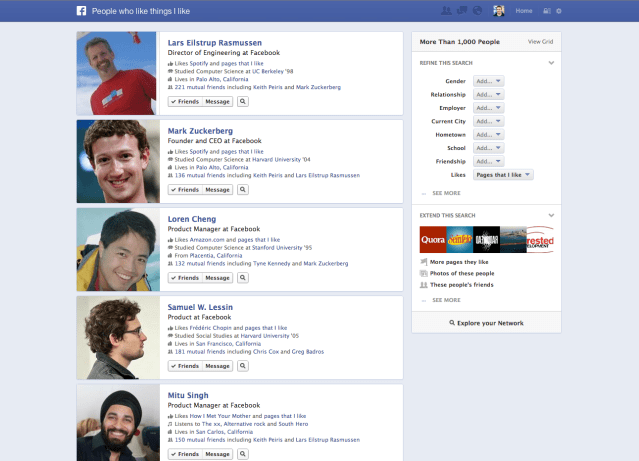
Facebook Graph Search, the company says, is rolling out slowly. It will leverage the social network’s own private data, honoring users’ privacy settings in the process of building this new search engine. Some things aren’t yet included, like individual Facebook posts and Open Graph actions (like song listens), the company says. But they’re coming.
Screenshot-PeopleWhoLikeThingsILike
It will make Facebook far more usable, and will therefore suck up even more of users’ time from Google Sites, which will be another blow to Google’s ads business.
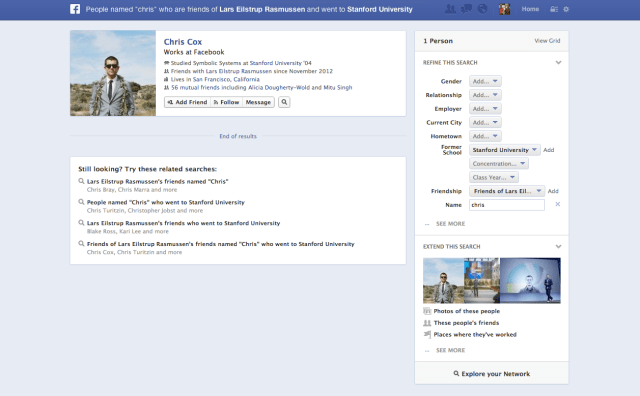
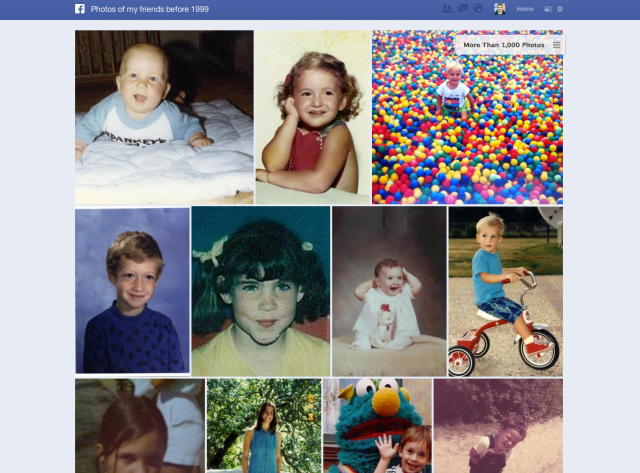
Facebook users will be able to search for friends, photos, restaurants and businesses nearby, games and music friends play, photos friends like and more. Much of this you can do on Facebook today, it just hasn’t been well-organized. Facebook currently has a search interface, but Graph Search will re-envision Facebook Search for a more powerful combinations of various search queries – “restaurants in New York liked by chefs,” “cities my family have been to,” “photos of friends from before 1999,” etc. Facebook Search is all about exploring your personal social connections, and those across Facebook.
Screenshot-PeopleNamedChris
This is a major step forward for defining what Facebook is to users: a social network turned search engine. And while it’s true that Facebook has leveraged a wealth of private data to build its engine on top of, it’s not the only company which is capable of doing so. Yes, Google may be starting from the other direction (search -> social instead of social -> search), but it’s not powerless here, despite the giant, and growing, private web behind Facebook’s doors.
Google, too, has been building its own social graph of sorts for its user base. While those visiting the destination site Google Plus may chalk up Google’s social efforts as that of building a Facebook clone with a few Google-fied bells and whistles, like video Hangouts, for example, Google’s true social efforts lie in unifying its user data across all its properties and services. Over the past year or so, Google has shut down unneeded and underused services (yes, including social search startup Aardvark!). It has combined its various user Privacy Policies into one, and have made users’ Google login the identification they use everywhere on Google from checking email to watching YouTube to searching for answers. It has streamlined Google and added a social layer to all of it.
YouTube is a pretty big social network, too, when you think about. 800 million monthly uniques. And Google hasn’t even fully realized the potential of switching on social on its mobile install base, via Android.
The company has access to other private data, too, which recently became available for public search tests. In August, it began letting users search their Gmail messages using Google.com. December, it then enabled an opt-in feature that lets users search for their online purchases, reservations, and other events using Google.com. The trick here is being able peer in users’ inboxes, and identify messages like order confirmations and receipts. It only feels vaguely intrusive because we believe our email is private. It’s not.
And Gmail, one could argue, is a social network filled with far more practical data for searching than “which photos my friends liked.”
Yet when it comes to the less practical – those photos, for instance – Facebook has the clear edge. 240 billion photos is just massive scale. Google, meanwhile, has let its Picasa photo-sharing service stagnate, confusingly, while also offering Google Plus Photos in its main social product. It’s time that Google stepped up its game on this front, and begin to merge the two properties properly, and transition users. (As a side note, Google offered instant (automatic, background) photo uploads from mobile a year and half before Facebook did. It also now has a dedicated easy upload app for YouTube.)
Photos could easily be Facebook’s battle to win.
As for the other data – venues suggestions and recommendations, travel ideas, etc. – well, remember that Google bought Zagat in 2011. Yes, Google saw this whole thing coming. Who hasn’t? Google is still making good on that purchase, too, having only recently relaunched Zagat on mobile. It has also merged Google Places (its business listings) into Google Plus Local. In Google’s preferred vision of the future, you might search for a restaurant, dine, rate and review the meal, and pay the establishment, all on Google. This could happen. That’s a lot of proprietary data, too.
Perhaps the biggest reason of all as to why the search battle is just now beginning is because we don’t yet know that search built on social search will definitely win long-term. Does social show early progress, in terms of Facebook ads, and specifically Exchange Ads? Yes it does. Can it transition that to mobile? Also possible.
Social search, likes, recommendations, etc., however, are built upon a potentially flawed idea: that our friends know best. They do not. Not always. Some friends have different tastes, and different interests. And some have just poor taste, let’s be honest. Does the fact that a friend bought a G&E washer mean I should too? (Maybe it was just on sale.) Does a friend’s check-in at Chez Louie equate to a recommendation? (Not without their accompanying rating or review. The food may have been terrible.) My friend went to Uruguay – should I consider that for my vacation? (They may have hated their hotel, who knows?).
A check-in, a place, a photo is not an answer. There’s more data needed here.
Then what about Facebook Likes? Sadly, Facebook advertisers have corrupted that data – “like our page for a coupon or deal!” Okay, liked. Hmm, now does the need for a discount mean a recommendation for a brand, though? That becomes less clear the more promotions are run.
Screenshot-PhotosOfFriendsBefore1999
While building a graph around what our friends and network is doing is an obvious no brainer for Facebook, it’s not necessarily the “next new thing” for search.
And if social is not the future of search, or if it’s only one small part, where then, is search going?Real answers. Facebook alluded to this in its announcement, saying exactly that: Graph Search is about answers, not links. But it doesn’t yet really have them.
Google is building its own answers engine too, however. It launched Knowledge Graph Search last year, which now delivers answers to fact-based questions. It launched a predictive, personalized search interface called Google Now on mobile, which knows what you need to know…and before you know you need to know it. That’s pretty disruptive.
Facebook is welcome entrant in search, but the games aren’t over just because it finally stepped onto the field.

Saturday, January 5, 2013

Five things Microsoft must do for Windows 8 in 2013


Microsoft's ambitious Windows 8 gamble may have launched this past October, but it's 2013 that will make or break the new operating system. I have five recommendations that Microsoft should implement sooner rather than later to keep Windows 8 from going the way of Vista.
Make the case for Windows RT
"That's right, it filets, it chops, it dices, slices, never stops, lasts a lifetime, mows your lawn, and it mows your lawn and it picks up the kids from school..." --Tom Waits, "Step Right Up"

Waits wasn't talking about Windows RT when he wrote and recorded "Step Right Up" in the mid-'80s, but he could've been. Microsoft wants the tablets that run the OS to be unifying devices that are portable like a tablet but powerful enough for the heavy lifting of Microsoft Office. Claiming that the OS can step up to that challenge, and actually proving that it can, are not the same thing.
Here's the problem with Windows RT: Even after writing CNET's FAQ on Windows RT, I still have problems clearly explaining what it is and why people should want it. It's "Windows 8 Lite," but it's so much more complex than that. Sure, the Surface is a nice piece of hardware, but besides its utility as a tablet-and-skateboard combo it's a hard sell.
I have a semibaked theory that Windows RT will become Windows 9, especially because of its ability to run on lower-powered, more secure ARM chips, but right now RT is closer to being the next Kin than the next Xbox.

Windows is not some in-development mobile operating system; it's the mature senior statesman of the computing world. It's on more computers than any other OS, and that's not going to change anytime soon. We know Microsoft wants the world to move as quickly as possible to Windows 8 -- there's no other explanation for the soon-to-expire $39.99 upgrade and the push for new, interesting, touch-screen hardware.Focus on apps
Though some Microsoft defenders point out that it took Google years to bulk up Android's app catalog to 500,000-plus titles, Redmond doesn't have that kind of time when it comes to Windows 8.

While it's true that Windows 8 can run legacy software just fine in Desktop mode, Metro apps are what will sell people. Some good apps currently available demonstrate the possibilities of Metro, but they don't offer a compelling reason to change your entire work flow.
The strength of iOS is that Apple's operating system is the cleanest around. Android basks in the glow of Google's best apps and services, from Gmail to Goggles to Translate to search. The Windows 8 app experience has yet to be defined, which could benefit Microsoft in that it has an open canvas to paint on.
The bad? Don't expect competitors to look the other way as Microsoft refines its app pitch to developers.
Microsoft's Panos Panay proudly shows off the Surface hardware at the company's unveiling event at Chelsea Piers in New York.
(Credit: Seth Rosenblatt/CNET)
Convertibles and hybrids need a Surface, too
The Surface hardware went a long way toward drumming up interest in Windows 8 and Windows RT, not to mention a lot of sturm und drang from Microsoft's hardware partners. While it could be interesting to see a Redmond-designed convertible or hybrid laptop, it's not strictly necessary. But what the burgeoning, occasionally confusing category does require is a hybrid or convertible that Microsoft can point to and exclaim to the public, "This!"

It may not want to, but right now all that we've seen are oversize tablet-tops with hinges. You can't easily tell people why they must have a new category of hardware without a signature device.
Wherefore art thou, settings and preferences?
Settings aren't sexy, but they shouldn't be confusing, either. Microsoft ought to make some decisions, and fast, about cleaning up the confusing mess of its under-the-hood options.

Sometimes they're behind the Settings charm in Metro. Other times they're buried in some Desktop mode window. Currently, I find it easiest to simply start typing for what I'm looking for, and let the powerful search tool do the hard work. But if Microsoft wants Windows 8 to have long-standing appeal for nonexperts, it's going to have to demystify this stuff.
Windows 8 has opens some settings from the Charm bar in the new Metro-styled interface, but others open in Desktop mode.
(Credit: Seth Rosenblatt/CNET)
Get people and businesses excited about Windows 8
Microsoft has done itself a great disservice by coming up with a fairly interesting, unique approach to the ecosystem problem, and then letting substandard marketing heighten people's questions and uncertainties.

Solving the above problems alone won't work without helping people realize what's so great about Windows 8. And without the massive license buys that businesses can provide, Windows 8 will struggle in a consumer marketplace that is increasingly turning to Macs to solve its problems.
How Microsoft can best do that I'll leave to greater marketing minds than myself. On some level, though, it would seem easiest to have compelling hardware that people want to use. The interest in the Surface is a step in the right direction, just as Samsung's Galaxy S3 and Google's Nexus 7 did wonders for Android. Maybe there's a killer "laptablet" coming at the beginning of next year, but there's little doubt that Windows 8 has a hard path to trek in 2013.

Thursday, November 29, 2012

Khan Academy Brings Its 3,500+ Educational Videos To The iPhone


Screen shot 2012-11-28 at 7.36.16 PM
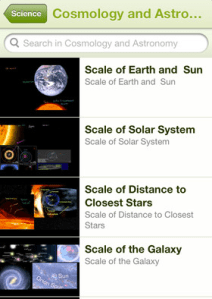
Whether or not one believes Khan Academy is helping to reinvent education, it’s hard to dispute the fact that Khan (and now his team) are an educational video-producing machine, or that the platform continues to diversify. In part, that started with the release of its iPad app in March. This week, Khan Academy brought its 3,600 videos to the iPhone.
This means that the company’s learning library is now accessible on the web, tablets and the iPhone and will likely be showing up on Android in the not so distant future. It may not seem particularly shocking given the exploding popularity of mobile, but it does seem notable when put in context.
Sal Khan started out creating tutorials on Yahoo’s Doodle Pad to help his cousin do her math homework. When other family members began asking for help, he posted them on YouTube. Fast forward to the present and Khan has gone on to create some 3,600 videos, which collectively have been viewed over 210 million times. Along the way, his instructional library became Khan Academy and gained support from the Doerrs, Bill Gates and many others, and Khan himself became the “teacher of the world” and the “Messiah of Math.”
The platform has done wonders for the dialogue around learning, and it’s true that its founder is doing his part to re-imagine what modern education should be. Of course, it’s also true that the media hype partially obscured some legitimate questions about the quality of Khan’s teaching, his pedagogy and whether or not video lectures really add up to Education 2.0.
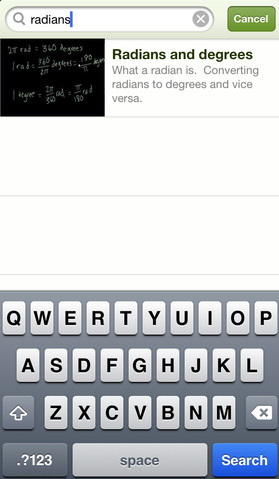
Nonetheless, the online learning academy continues to press on. As part of the latest update to its iPad app, the company added support for the iPhone, which now allows users to access its library of videos on the go. Unlike Khan’s iPad and web apps, the new app doesn’t include the ability to download the videos so that they can be watched offline, subtitles, or track your progress through the academy and unlock achievements. Instead, the app simply allows you to watch videos.

This might make the app seem undercooked — and in a way it is — but it could actually be a smart move given the limited form factor. Stuffing the entire Khan Academy experience onto the iPhone’s screen likely would diminish the experience of its visualization tools, interactive transcriptions and some of its better gamification and progress-tracking features.
Nonetheless, by opening up the Khan experience to iPhone users, they can now access Khan’s instructional videos on the go, while on the bus or during long car rides — all of which is huge for students and fans of the educational platform.
It exposes a huge swath of potential learners to Khan’s 3,600 videos, which range from math and chemistry to physics and biology. While it may be old news to some, as Khan first leaked images of its new iPhone app over a week ago, it’s still a worthwhile addition to the lexicon and a sign that it’s continuing to push forward.

Thursday, November 15, 2012

Creative USB with Display


Designer: Yiyan Cao


U Transfer USB stick eliminates the need for using a computer as a medium to transfer information from one stick to another. It is equipped with a display that is hopefully a touchscreen, and has a slot at one end to hook up another stick. File transfers promise to be easy, and I can imagine myself using this stick at live blogging events.

Fun time, Fun swimming: Big Boat Dragovic Yacht

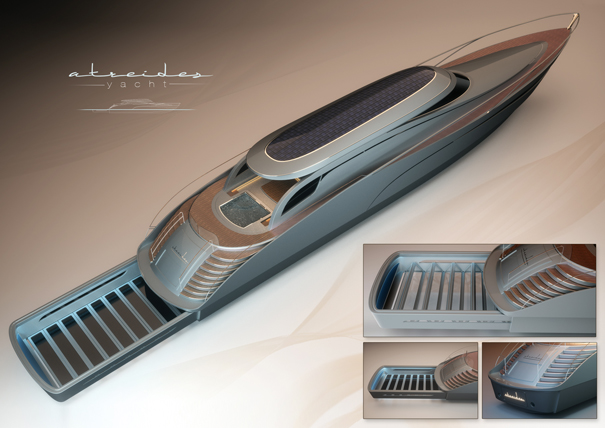
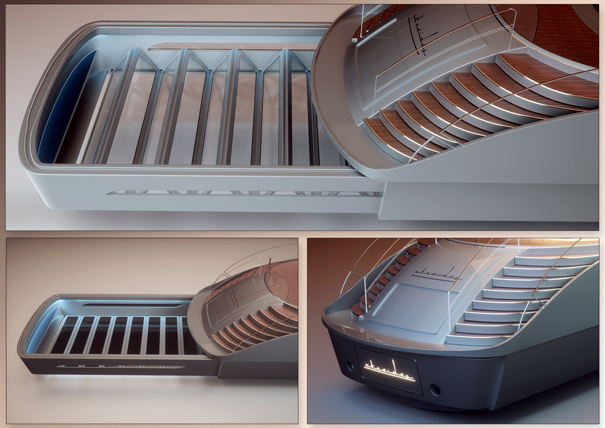
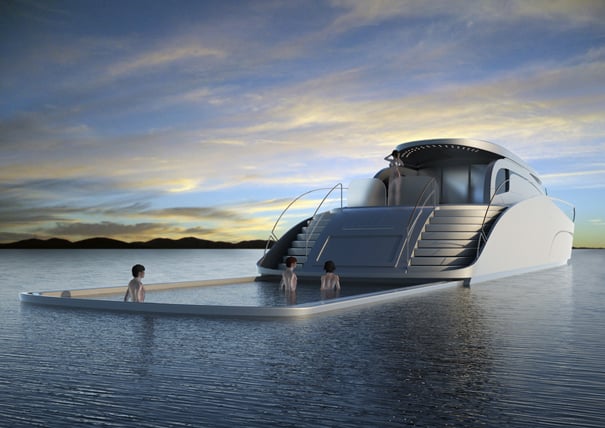
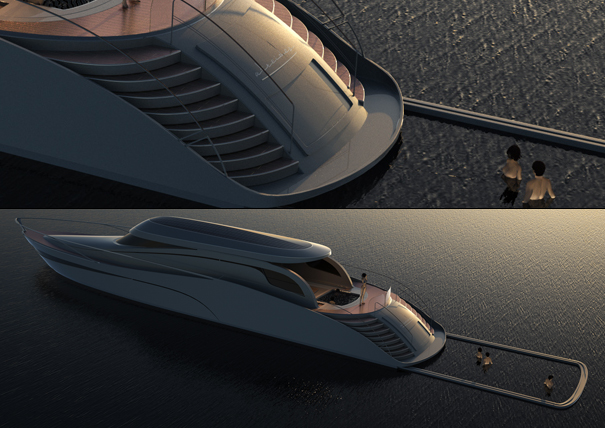
With a name like Vuk Dragovic, one doesn’t need to go very far to find a unique name for any sort of design they’ve made and need to name. However! Dragovic does also happen to be a world-class name-creator too, so the concept you’re about to look at goes by the name “Atreides Yacht” and lives up to the elegance of the letters that title it. And it’s got some radical innovation on it’s side too, hooray! And not just in the greener section of things. It’s got a fully extendable shallow pool that shoots out the back.

This is innovation in fear! That is, helping everyone have a fun time, a fun swimming time, even if you’re in your yacht in the middle of the deep blue sea. At the back of the boat there is a frame that slowly emerges out as it’s activated. Once extended, the swimming can begin. Stored in a sort of zig-zag pattern, extended this back section comprises of a border and a floor, all you need for complete safety from sharks.
While the front of the boat is meant for speed, the back is meant for rest and play. The roof’s got solar panels which help store energy to charge all the boat’s lights, pool mechanisms, and smaller fuel tank.
This boat comes in two sizes: rich and SUPER RICH. I feel obligated to say something to that effect every time I write about something there’s no way I’ll ever be able to afford. However, everyone should take the time to dream, especially if they happen to be a designer and want to be the person to take all the rich people bucks. Get that money!
 

Designer: Vuk Dragovic

 
atreidesyacht01
Atreides Yacht by Vuk Dragovic
atreidesyacht03
atreidesyacht04
atreidesyacht05

Sony Digital Recording Binoculars


image from www.ultraportabletech.com
The Sony Digital Recording Binoculars are the first of it's kind. This unique concept is now a reality with 2 models to choose from. The world's first binoculars can capture Full HD 1920 x 1080 resolution video in 2D or 3D—plus 7.1MP stills. Impressed?! With a 10X zoom it's perfect for wildlife watching or sporting events. These binoculars offers continuous auto focus while zooming so your videos won't be blurry. These binoculars will also perform very well in low light situations because of the Sony Exmor R CMOS sensor. A very nice piece of equipment for those who want to a camcorder, camera, and binoculars in one. Sony DEV-3 Digital Recording Binoculars, Black
Sony DEV-5 Digital Recording Binoculars, Black
image from www.ultraportabletech.com

The future of higher education: reshaping universities through 3D printing


The Future of Higher Education Reshaping Universities through 3D Printing
Featuring four towering limestone columns and classic Flemish-bond brickwork, the century-old Mackay School of Mines Building at the University of Nevada, Reno, has long served as a bastion of Silver State history. Named after Irish immigrant and "Comstock Lode King" John Mackay, notable touches such as a cast bronze statue designed by Mount Rushmore sculptor Gutzon Borglum just outside the building helped it earn a spot in the National Register of Historic Places. Within its oak doors, however, are the makings of an intriguing experiment that's decidedly more new school. Like a mini museum, a collection of 3D-printed models are displayed within the building's sunlit, three-story atrium -- attracting a mix of students and teachers. Even more popular than the displays of plastic gears and molecule models, however, are the two 3D printers that made them: a professional-grade Stratasys uPrint SE Plus and a hobbyist 3DTouch machine by 3D Systems Corporation.
"If you look back at libraries over 2,000 years -- including the Library of Alexandria -- you'll see that they were involved in buying technology that many people cannot afford and making them more accessible," Colegrove said. "Along the way, it became all about having the biggest and best book collection so you ended up having identical libraries. We lost our way."
Paper or plastic?
DNP Future of Higher Education Reshaping Universities through 3D Printing
For Colegrove, part of libraries losing their way involves the quiet, sanitized atmosphere that pervades many such facilities today. In the old days, libraries were largely about the conversation -- a fundamental part of learning and human nature, he said.
One section of DeLaMare Library's walls, for example, is covered in whiteboard paint, which makes it easier for students to write out their ideas or map out calculations in groups.
"The biggest mistake we made is when we let books crowd out the users and libraries became a quiet place where there's no talking and no food and drinks," Colegrove said. "We need to adjust from having conversations in users' heads to a collaborative environment."
"The biggest mistake we made is when we let books crowd out the users and libraries became a quiet place."
In order to take DeLaMare to the next level, Colegrove felt that it needed an anchor to draw in the diverse set of people needed to make creative collaboration possible. That's when he started thinking about 3D printers. Although the devices have been around since the '80s, 3D printers are still a relatively new concept to most people and just recently became more accessible to average consumers. The novelty of using layer after layer of melted plastic to "print" actual three-dimensional objects also gave 3D printers a "cool factor." Add the ability to turn people's ideas into something that's physically tangible and you have technology that could serve an educational purpose as well, Colegrove thought.
As great as 3D printers sounded, however, the library still faced one challenge: cost. Although it was possible to get a printer like the MakerBot Replicator for around $2,000, Colegrove wanted a higher-end machine that could print faster at a high resolution while also being able to handle a heavy demand reliably. He decided to pick two devices -- the $20,000 Stratasys uPrint SE Plus professional-grade printer and a $4,000 3DTouch hobbyist machine. Throw in the cost of a 3D scanner and about a year's worth of plastic material and the library was looking at an expense between $30,000 and $40,000.
With the university system facing steep budget cuts after the Great Recession razed the state budget, Colegrove was apprehensive about pitching his plan to his superiors. After much thought, he decided to take the chance.
"When I first thought about getting funding from the school for the 3D printers, I was worried about the cost," Colegrove said. "But one of the people I talked to said, 'Oh, that's nothing, it's just the price of one microscope.' After that, I was like, 'OK, I don't feel so bad.'"
A matter of perspective
DNP Future of Higher Education Reshaping Universities through 3D Printing
Thanks to a combination of university gift funds and grants, the library soon acquired its two 3D printers. The 3DTouch arrived first on April 27th and was printing its first job -- a rotor for an impeller pump prototype designed by a group of engineering students -- just minutes later. The rotor would take three days to finish.
"The students just broke the box open and started printing right away," said Lisa Kurt, DeLaMare's engineering and emerging technologies librarian. "They just looked so excited and you could feel this tremendous energy."
"It's really heartwarming to see just how backed up the machines are."
The library's Stratasys uPrint SE Plus arrived two months later on June 27th. The Stratasys, which prints four times faster than the 3DTouch and is jokingly described by Colegrove as their "Mercedes- Benz," has been running constantly since starting operation on July 3rd. Students have printed a range of devices that run the gamut from a bust of Master Yoda and RepRap 3D printer parts to intricate models of molecules and an engine block. Several of the creations churned out by the devices are now on display next to the printers, along with a "Box of Disappointment" that contains discarded pieces that didn't quite turn out perfectly. For Colegrove, the strong demand for the printers validated his bet to bring the technology to the library.
"It's really heartwarming to see just how backed up the machines are," Colegrove said.
The waiting list got even longer in August, when the 3DTouch was taken offline due to a print head issue. The library also plans to replace the 3DTouch's build platform with a heated version after some projects printed from the device exhibited signs of warping.
Meanwhile, the library's "one-year supply" of 35 total PLA and ABS plastic spools is down to just a third of the original amount after only a couple of months. The supply issue should rectify itself once the university starts charging for the material -- 50 cents per cubic inch for 3DTouch jobs and $4.50 per cubic inch for the higher-resolution Stratasys. Kurt says strong demand will continue to be an issue now that students are back for the fall semester.
"Word has caught around campus and we were already busy even during the summer months," Kurt said. "But it's a good problem to have. I'd rather have people coming in to the library to use the printers than have an empty room."
A new dimension in learning
DNP Future of Higher Education Reshaping Universities through 3D Printing
For many universities, 3D printers have become an indispensable asset for promoting learning and education. At Columbia University's Graduate School of Architecture, Planning and Preservation (GSAPP), the devices are considered a regular tool in student's everyday lives, said Carlito Bayne, manager of the GSAPP's Output Shop. He says the school has dabbled with 3D printers since 2000, including one that used wax. Their printers get so much use that the school is purchasing another machine. Other departments such as the fine arts, medical and engineering schools have their own 3D printers.
"During presentations most students have models as well as renderings to show the design process," Bayne said. "It shows the students and professors what works structurally and what just looks good. This is something that a 2D render or drawing can't do because you only have one view."
"I think it's creating a Renaissance in manufacturing and the design world because even the average person can use it."
At the Massachusetts Institute of Technology, students such as Steven Keating are using 3D printers in cutting edge ways that go beyond simple models. The mechanical engineering student describes 3D printers as a valuable research tool because they can help accelerate projects that would normally take time using conventional modeling methods. The technology also helps democratize processes that may be too technical for the average person when done the traditional way.
"3D printing allows you to prototype rapidly and iterate quickly so it really levels the playing field in terms of design," Keating said. "Anyone with a program like Sketchup can design something without needing access to a machine shop or knowing how to operate fabrication equipment. I think it's creating a Renaissance in manufacturing and the design world because even the average person can use it."
In Keating's case, he is currently part of a team that's studying new digital fabrication techniques, including large-scale 3D printing. Their ultimate goal? To be able to print entire buildings. Part of Keating's research is to come up with an alternative to the current layer-by-layer printing method used by machines such as the Makerbot, which is too slow for their purposes. One approach they are developing is to "print in place" -- which allows for printing to be done on site. Their concept also uses "mobile swarm printing" via robotic agents that extrude a fast curing material. The material acts as a concrete mold for structural walls and also doubles as a thermal insulation layer. In addition to lower costs and the ability to print custom shapes, the unique approach gives the team the speed that they desire. "We estimate that for a regular single-story residential house, we can print the entire exterior wall in under a day," Keating said. "So far, we've performed a lot of small scale tests successfully so we're hoping to work on a larger scale within the next year."
The next level
DNP Future of Higher Education Reshaping Universities through 3D Printing
Although printing models of molecules, gears and even hobbyist projects in plastic are a good first step, one of the things that excites researchers about 3D printing involves its potential for using other materials. One example is using the technology for biological projects, including the creation of human tissue, said Ali Khademhosseini, a Harvard Medical School associate professor who's also involved with the Harvard-MIT Division of Health Sciences and Technology. Khademhosseini and his fellow researchers are currently trying to engineer 3D structures that mimic cells and tissues that can be transplanted into humans. Unlike the more inanimate materials traditionally used, printing tissue material requires a different kind of medium that comes with its own set of unique challenges. "We typically deal with gels and pregel liquids where you have cells encapsulated inside," Khademhosseini said. "Once printed, you can cross link them and make a gel-like structure, so the material is different ... and very hydrated."
"The challenge now is making things like heart tissue, which is more vascularized and has all these blood vessels."
In the past, researchers tried to repurpose traditional printers for the job but ran into issues such as clogging. These days, they use printers from companies such as San Diego-based Organovo that specialize in printing biological material. The research could help speed up clinical trials by creating cells and tissues that can be used for testing drugs, Khademhosseini said. Larger trials, which can cost upward of a billion dollars, may also benefit by seeing reduced costs. So far, researchers working on biological printing have already created viable material for treating burned skin. More complicated tissues, however, will still take some time.
"The challenge now is making things like heart tissue, which is more vascularized and has all these blood vessels, or liver tissue, which has a metabolic function," Khademhosseini said. "There still are formidable challenges but we're making a lot of progress. Just being able to make tissues for drug discovery is already a big deal."
Meanwhile, printing speed remains a challenge for 3D printers overall, said Pedro Reis, an assistant professor of mechanical, civil and environmental engineering at MIT. Although 3D printing certainly has advantages as a prototyping tool, it still lags behind more traditional manufacturing methods when it comes to mass producing items, according to Reis. Nevertheless, its advantages as a tool for unlocking human creativity both individually and collaboratively can't be minimized.
"When you look at some of the crazy 3D objects that students come up with, you can't help but just go, 'Wow,'" Reis said. "It really empowers them and opens up their imagination. It opens up a completely new door for them to express their ideas."
More heads better than one
DNP Future of Higher Education Reshaping Universities through 3D Printing
Sunlight seeps into the bustling DeLaMare atrium on a sunny Tuesday afternoon as visitors arrive to hang out around the 3D printers and observe the progress of their projects. In one corner, a teacher checks out one of the molecule models printed by a colleague and starts chatting with a computer science engineering student who's fiddling with the 3D scanner nearby. For Ben King, an associate professor of chemistry at the school, one of the challenges in making the connection between science and technology is the gulf in communication between people. Using 3D printers, he said, not only encourages people to flesh out their ideas and potentially create the next cool widget; it also makes it easier to communicate one's results to people outside one's field of expertise.
"For example, one of the very hard things about teaching chemistry is explaining that molecules have shape," King said. "This basically removes that obstacle ... so it will change how we teach chemistry and how we look at molecules on a daily basis. It's also just plain fun."
Guilherme Martins, a graduate student in the computer science and engineering program, agreed.
"In the field of robotics or mechanical engineering, the ability to create a moving part without any welding removes a lot of the barriers to prototyping," Martins said. "Using 3D printers also encourages you to learn something like a 3D modeling program so it pushes you to learn new skill sets."
On the other side of the room, one student can be seen interacting with another student at a nearby table while holding a sandwich in one hand and a drink in the other. Instead of telling the visitors to keep quiet and to dispose of their food, Colegrove joins in on the conversations.
"When I first came in (a couple of years ago), I talked to the dean and said, 'You know, scientists and engineers are known for a lot of things but they're not really known to be quiet people,'" Colegrove said. "We need to get that community back in the library."
"It allows us to break out of the box and cross-pollinate in ways that we normally can't. Cool stuff happens when you get people together."
The biggest benefit Colegrove has seen so far is the increase in visits from people of other backgrounds. As the library for one of the top mining schools in the country, DeLaMare has a strong history in the geosciences. With the addition of the 3D printers, the school's geological minds are now rubbing elbows with people from fields such as biology, computer science and even art.
Chris Bennett, a computer science engineering sophomore, said he especially enjoys the networking aspect of his visits to the 3D printing area. He briefly chatted with civil engineering senior Alicia Veach, who is planning to use the 3D printers to create miniature prototypes of the concrete canoes she and her team use in racing competitions around the country.
"You get your average engineering types but it's also nice to see the biologists and the artists coming in here," Bennett said. "It allows us to break out of the box and cross-pollinate in ways that we normally can't. It's basically tied to the Makerspace ethos -- cool stuff happens when you get people together."
This diverse meeting of the minds is exactly what Colegrove hopes to continue seeing as more folks become aware of the 3D printers. Colegrove alluded to the Gartner Hype Cycle, which explains the various phases that a technology goes through during adoption. The cycle starts with the creation of the technology followed by inflated expectations, disillusionment, enlightenment and the final phase of acceptance. Colegrove believes that 3D printers have passed the "disillusionment" phase that comes when a new technology fails to match the hype of inflated expectations. Instead, 3D printers are now starting to work their way up the "slope of enlightenment" stage, where most progress is achieved. How fast that translates to printing organs and Star Trek-style replicators, however, depends on how many people start playing with the technology now, he said. The key is collaboration, which speeds up the learning process, he added.
"The old model -- where you have individual silos and people went into their individual towers -- I mean, what good is that?" Colegrove said. "Now you have engineers talking with artists and creating new forms of knowledge. Instead of the old teaching model where you have the sage on the stage, the new model is about learning from one another to create a spark that can be fanned into a flame. You end up connecting all these dots."
Clarification: The University of Michigan 3D Lab also provides limited 3D printing services to the public on a case-by-case basis, provided there is space in the printing queue after students and faculty.
This piece originally appeared in Distro Issue #61.